Bali is one of the most visited islands in the world. And for good reason. It has beaches, jungles, rice fields, temples, good food, and some of the best sunsets you’ll ever see. Whether you’re going solo, with a partner, or in a big group — Bali works for almost everyone.
This guide covers everything. From how to get there to what to eat, where to stay, and how much to budget. We’ve also added sections the competitor guide missed — like visa info, a budget breakdown, and safety tips.
How to Get to Bali?
All flights land at Ngurah Rai International Airport (DPS) in Denpasar. This is the only major international airport in Bali.
There are no direct flights from most Western countries. You’ll usually connect through:
- Dubai (Emirates)
- Singapore (Singapore Airlines, Scoot)
- Kuala Lumpur (AirAsia, Malaysia Airlines)
- Hong Kong or Tokyo (Cathay Pacific, JAL)
- Sydney or Melbourne if coming from Australia (Qantas, Jetstar)
Other airlines that fly to Bali:
- Qatar Airways
- Etihad Airways
- British Airways
- Garuda Indonesia
- KLM
Flight times (approx.):
| From | Approx. Flight Time |
|---|---|
| London | 16–18 hours (1 stop) |
| Dublin | 18–20 hours (1–2 stops) |
| New York | 22–26 hours (1–2 stops) |
| Sydney | 6–7 hours (direct or 1 stop) |
| Singapore | 2.5 hours (direct) |
Pro tip: Book flights 3–5 months in advance for the best prices. Prices spike during July, August, and December.
Do You Need a Visa for Bali?
This is one of the most common questions — and it’s often left out of travel guides. Here’s what you need to know.
- Most Western passport holders (UK, EU, US, Australia, Canada) get a free visa on arrival for up to 30 days.
- You can extend it once at an immigration office for another 30 days (total 60 days).
- As of 2024, Indonesia also launched a Bali Social Cultural Visa for longer stays (up to 180 days).
- You’ll need proof of onward travel and enough funds in your bank account (roughly $1,000 USD suggested).
Always check the latest entry rules before you travel, as these can change.
Best Time to Visit Bali
Bali has two main seasons:
| Season | Months | What to Expect |
|---|---|---|
| Dry Season | May – October | Sunny, less humidity, best for beaches |
| Wet Season | November – April | Short heavy showers, lush green, lower prices |
Best months: July and August are peak season. It’s busy and prices are higher. If you want fewer crowds, go in May, June, or September — still dry but much quieter.
Wet season tip: Don’t let the wet season scare you. Showers are usually short (30–60 mins) and often happen at night. You can still have a great holiday.
Where to Stay in Bali?: Best Areas
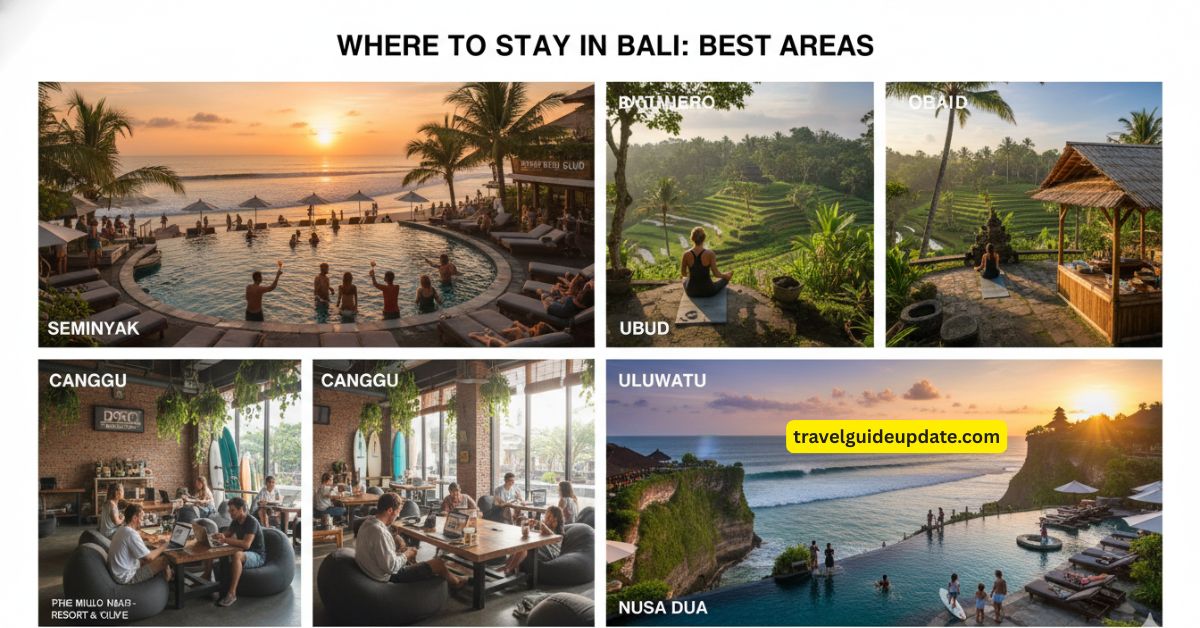
Bali is split into several distinct areas. Each has a very different vibe. Here’s a quick breakdown:
Seminyak — Best for Nightlife and Beaches
Seminyak is trendy and lively. It has great beach clubs, restaurants, and shops. It’s great if you want to be close to the action. A bit busier and more built up than other areas.
Best for: Couples, groups, first-timers who want convenience.
Ubud — Best for Culture and Nature
Ubud is inland, surrounded by rice fields and jungle. It’s calm, creative, and deeply spiritual. Great for yoga, art, and cooking classes. This is the cultural heart of Bali.
Best for: Solo travellers, wellness seekers, couples who love nature.
Canggu — Best for Digital Nomads
Canggu has a cool, laid-back surf town feel. Lots of cafés, co-working spaces, and healthy food spots. It’s very popular with remote workers and young travellers.
Best for: Digital nomads, surfers, 20s and 30s crowd.
Uluwatu — Best for Surfing and Cliffside Views
Uluwatu sits on a dramatic clifftop at the southern tip of Bali. The sunsets here are stunning. The surf is world-class. It’s more remote and quieter than Seminyak.
Best for: Surfers, couples, those who want something quieter.
Nusa Dua — Best for Luxury Resorts
Nusa Dua is home to large 5-star hotel resorts and calm beaches. It’s very clean and organised. Less “local” feel but great for luxury stays and families.
Best for: Families, honeymoons, luxury travellers.
Where to Stay?: Villas vs Hotels
If you’re travelling in a group of 4 or more, villas are almost always the better choice in Bali. Here’s why:
- Most villas come with a private pool
- You get more space
- They’re often cheaper per person than hotels
- Many come with staff including a cook, cleaner, and security
Solo or couple? A boutique hotel or guesthouse (called a “losmen”) can be very affordable and charming.
Budget options: Hostels in Canggu and Seminyak start from around $10–$15 USD per night.
Getting Around Bali
Ride Apps
- Grab and Gojek are the main ride-hailing apps in Bali. They’re cheap, easy to use, and more reliable than hailing a street taxi.
- Blue Bird Taxi is a trusted metered taxi company. Always use metered taxis if you’re not using an app.
Private Drivers
For day trips or longer journeys, hire a private driver for the day. It costs around $35–$60 USD for a full day and is well worth it. Your hotel or villa can usually arrange this.
Scooter Rental
Renting a scooter is very common in Bali and costs around $5–$8 USD per day. It gives you a lot of freedom. But be aware:
- Traffic in busy areas like Seminyak can be chaotic
- Always wear a helmet
- You’ll need an international driving licence (or a local one)
- Stick to quieter roads like those in Ubud if you’re not confident
Read: United Airlines Flight UA82 Emergency: Cause, Timeline & Passenger Rights
Budget Breakdown: How Much Does Bali Cost?
One of the best things about Bali is that it suits almost any budget. Here’s a rough idea:
| Category | Budget | Mid-Range | Luxury |
|---|---|---|---|
| Accommodation (per night) | $10–$25 | $40–$100 | $150–$500+ |
| Meals (per day) | $5–$10 | $15–$30 | $50–$100+ |
| Transport (per day) | $5–$10 | $15–$25 | $30–$60 |
| Activities (per day) | $10–$20 | $25–$60 | $80–$200+ |
| Daily Total | $30–$65 | $95–$215 | $310–$860+ |
Money tips:
- Use ATMs at reputable banks (BCA, Mandiri, BNI)
- Avoid airport money exchanges — the rates are poor
- Always carry some cash (Indonesian Rupiah) — many local warungs and markets don’t take cards
- Tell your bank you’re travelling before you go
Top 8 Things to Do in Bali
1. Hike Mount Batur for Sunrise
This is one of the best things you can do in Bali. Mount Batur is an active volcano. You hike up in the dark (around 2–3 AM start) and reach the summit just in time for sunrise. The view is incredible — layers of pink and gold sky over a crater lake.
- Hike time: About 2 hours up
- Difficulty: Moderate — mostly steep but no technical climbing
- Cost: Around $35–$60 USD with a guide (guides are highly recommended)
- Best tip: Book a guide through your hotel or villa
2. Visit Sekumpul Waterfall
One of the most beautiful waterfalls in all of Bali. It’s about a 2-hour drive from Seminyak. The hike down takes around 30 minutes on a muddy path with steep steps. But when you get there — it’s worth every step. You can swim right at the base of the falls.
Pack: Water, snacks, towel, a spare change of clothes, and shoes that can get wet.
3. Surf in Uluwatu
Uluwatu has some of the best waves in all of Asia. Even if you’ve never surfed before, there are surf schools here that are great for beginners. If you’re more advanced, the breaks like Padang Padang and Bingin are legendary.
Beginner tip: Book a lesson with a surf school. Instructors go in the water with you and it’s a brilliant day out.
4. Explore Ubud’s Monkey Forest
The Sacred Monkey Forest in Ubud is home to over 1,000 long-tailed macaque monkeys. It’s fascinating — but come prepared.
Warning (and we really mean this):
- Remove jewellery, earrings, and sunglasses before entering
- Zip up every pocket and bag
- Don’t make direct eye contact with the big ones
- Don’t hold food in the open
The monkeys will steal from you. They’re clever and quick. But as long as you’re smart about it, it’s a really fun experience.
Cost: Around $5 USD entry fee.
5. Snorkel Around Nusa Penida
Nusa Penida is one of three islands about 30 minutes by speedboat from Bali. The water here is crystal clear and the sea life is incredible. You can swim with manta rays, see colourful coral, and spot sea turtles.
Day trip tip: Go early — boats get busy and afternoon currents can be strong.
6. Watch a Kecak Fire Dance at Sunset
The Kecak dance is a traditional Balinese performance. It’s held at the Uluwatu Temple cliff at sunset. Around 100 men in sarongs chant in chorus while performers act out the Ramayana story — all with the ocean as a backdrop.
Cost: Around $10–$15 USD. One of the best value experiences in Bali.
7. Take a Cooking Class in Ubud
Balinese food is some of the best in South East Asia. Taking a cooking class is a hands-on way to really connect with the culture. Most classes start with a market trip to buy ingredients, then you cook 4–6 traditional dishes and eat them for lunch.
Cost: $25–$45 USD. Highly recommended.
8. Explore the Tegallalang Rice Terraces
These terraced rice paddies are a UNESCO-recognised landscape. Walking through them at golden hour is something you won’t forget. The terraces near Ubud are the most famous and easiest to reach.
Cost: Small entrance fee (~$1–$2). Some walkways charge separately.
Food in Bali: What to Eat and Where?
Balinese food is fresh, bold, and often very affordable. Here are some dishes you should try:
- Nasi Goreng — Fried rice with egg, veggies and sometimes chicken or prawn. It’s on every menu and it’s usually great.
- Babi Guling — Balinese spit-roasted pork. A local favourite.
- Mie Goreng — Fried noodles. Quick, cheap, and tasty.
- Satay — Grilled skewers with peanut sauce. Get them from street stalls.
- Lawar — A traditional Balinese salad with minced meat, vegetables, and coconut.
- Fresh Smoothie Bowls — Bali is famous for its healthy café culture. You’ll find açaí and smoothie bowls everywhere, especially in Canggu and Ubud.
Where to eat:
- Warungs (local small restaurants) are the cheapest and most authentic option. Meals cost $1–$4 USD.
- Mid-range cafés are everywhere in Seminyak and Canggu — expect to pay $5–$15 USD per meal.
- Beach clubs like Potato Head and Ku De Ta are for sundowners and splurging — meals and cocktails will cost more.
Safety Tips for Bali
Bali is generally very safe for tourists. But there are some things worth knowing.
- Petty theft can happen in busy tourist areas. Keep bags zipped and don’t leave valuables on the beach.
- Water safety: Don’t drink tap water. Stick to bottled water or filtered water from cafés.
- Traffic: Bali traffic, especially in Seminyak and Kuta, is chaotic. Be very careful if riding a scooter. A lot of tourist injuries happen on mopeds.
- Sunscreen: The Bali sun is very strong, even on cloudy days. Use SPF 50. Reapply every 2 hours.
- Mosquitoes: Use insect repellent, especially in the evenings. Indonesian brands tend to be stronger.
- Scams: Taxi drivers who don’t use meters, and fake tour operators do exist. Use Grab/Gojek for rides and book tours through your hotel or a trusted agency.
- Respect local customs: Bali is deeply religious. Dress modestly when visiting temples (sarongs are usually provided). Don’t touch sacred objects.
What to Pack for Bali?
Keep it light. The humidity is real. Here’s a smart packing list:
Clothing:
- Light cotton or linen tops
- Shorts and loose trousers
- Silk or lightweight dresses (also for temple visits)
- One light jumper or layer for flights or cool evenings in Ubud
- Swimwear
- Long-sleeve rash guard or swim shirt (for surfing or snorkelling)
Footwear:
- Sandals (Birkenstocks or similar)
- Grip trainers for hikes and activities
- Flip-flops for beach and pools
Essentials:
- SPF 50 sunscreen — bring plenty, or buy local brands on arrival
- Insect repellent (DEET-based for better protection)
- Reusable water bottle with a filter
- Universal travel adapter (Type C sockets in Indonesia)
- Waterproof phone case or dry bag
- Small first aid kit with antihistamines, stomach tablets, and antiseptic
Documents:
- Passport (valid at least 6 months beyond travel dates)
- Travel insurance documents
- Printed or digital copy of your accommodation bookings
A Sample 7-Day Bali Itinerary
| Day | Area | What to Do |
|---|---|---|
| Day 1 | Seminyak | Arrive, settle in, dinner at a local warung |
| Day 2 | Seminyak | Beach, Ku De Ta sunset drinks, explore shops |
| Day 3 | Uluwatu | Surf lesson, Kecak fire dance at sunset |
| Day 4 | Ubud | Tegallalang rice terraces, cooking class |
| Day 5 | Ubud | Monkey Forest, temple visit, art market |
| Day 6 | Mount Batur / Nusa Penida | Early sunrise hike OR island snorkel day trip |
| Day 7 | Seminyak | Sekumpul Waterfall day trip, final dinner |
FAQs About Travelling to Bali
Is Bali safe for solo travellers? Yes. Bali is one of the most solo-friendly destinations in the world. Solo female travellers visit regularly. The locals are warm and helpful. Just follow standard travel safety — don’t walk alone in dark areas late at night, and use trusted transport apps.
How much cash should I bring? It’s good to have some cash in Indonesian Rupiah (IDR). You can withdraw from ATMs on arrival. Bring a small amount of USD or your home currency to exchange if needed. Most mid-range and upscale restaurants accept cards but smaller warungs and markets are cash only.
Is Bali good for families with kids? Very much so. Nusa Dua has calm beaches and family-friendly resorts. There are also water parks, animal parks, and cultural shows kids enjoy. The food is generally varied enough for picky eaters.
What religion is practised in Bali? Around 87% of Balinese people practise Hinduism — which is unique to Bali within Indonesia (the country is majority Muslim). You’ll see temples, offerings, and ceremonies everywhere. It’s a deeply spiritual place and visitors should be respectful.
Do I need travel insurance for Bali? Yes. Always. Medical care can be expensive for foreigners in Bali. Make sure your policy covers scooter accidents, emergency evacuation, and water activities if you plan to surf or snorkel.
Can I use my phone in Bali? Yes. International roaming works but can be expensive. A better option is to buy a local SIM card at the airport on arrival. Telkomsel is the most reliable network. Data is cheap — around $5–$10 for several GB.
Is the water safe in Bali? Tap water is not safe to drink. Use bottled water or filtered water. Many cafés and hotels provide free refill stations.
What language do people speak in Bali? Bahasa Indonesia is the national language. Balinese is also widely spoken locally. In tourist areas, English is very commonly understood.
What currency is used in Bali? Indonesian Rupiah (IDR). As of 2025, roughly 1 USD = 16,000 IDR. Always compare exchange rates before converting money — airport rates are usually the worst.
Is it rude to bargain in Bali? At markets and with street vendors, bargaining is expected and normal. In shops with set prices and in restaurants, don’t haggle. A good rule: offer 50–60% of the asking price and negotiate from there.
Final Thoughts
Bali is more than just a tropical holiday destination — it’s a place filled with culture, adventure, stunning landscapes, and unforgettable experiences. From relaxing on beautiful beaches and exploring rice terraces to tasting local food and watching magical sunsets, every part of Bali offers something unique. Whether you’re travelling on a budget or planning a luxury escape, Bali in 2026 remains one of the best destinations in the world for couples, families, solo travellers, and digital nomads alike. Plan smart, respect the local culture, and get ready for a trip you’ll remember for years.