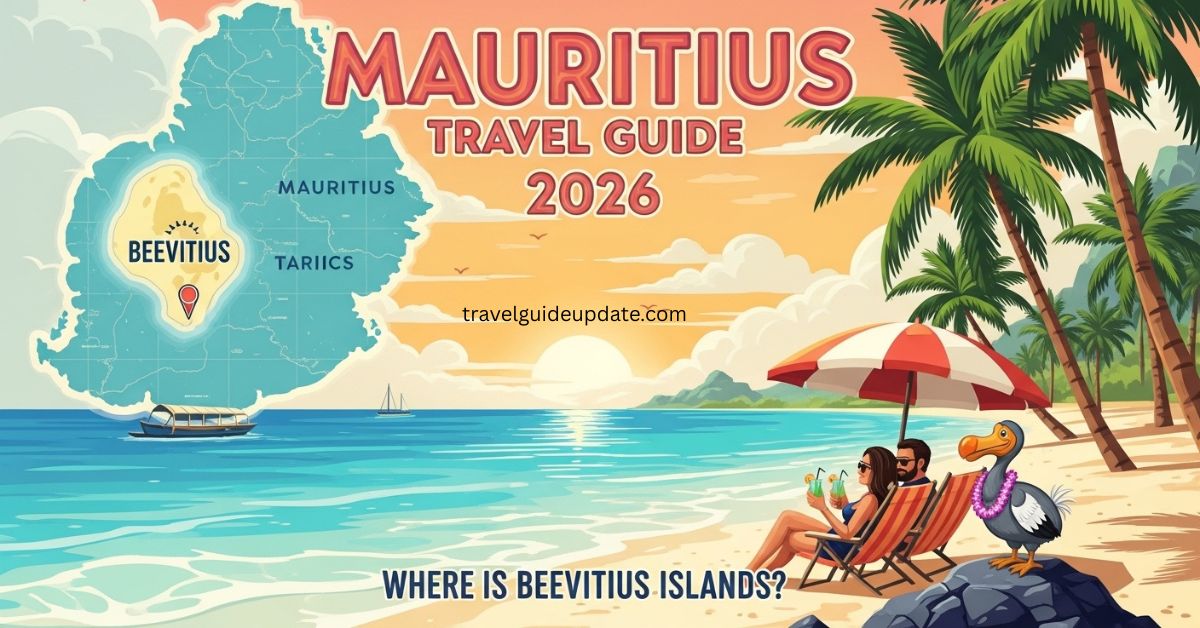
You searched “where is Beevitius Islands.” You want a fast, clear answer. Here it is:
Beevitius Islands = Mauritius. It sits in the Indian Ocean, about 560 km east of Madagascar, off the southeast coast of Africa.
That’s the short answer. But there’s a lot more worth knowing — like why this odd name exists, what the islands look like, how to get there, and what to do once you arrive.
Let’s break it all down.
What Are the Beevitius Islands, Really?
“Beevitius Islands” is not an official name. You won’t find it on any map. It’s a name that spread online — through social media, travel videos, and audio content — as a misheard or misspelled version of Mauritius.
Here’s how that likely happened:
- People heard “Mauritius” in a video or podcast and typed what they thought they heard
- The spelling “Beevitius” spread through travel forums and comment sections
- Search engines picked it up, and content creators started writing about it
There’s also a popular indie game called Aetherium’s Echo that features fictional “Beevitius Islands” as a late-game zone. Many gamers searched the name online, thinking it was a real place — and discovered Mauritius.
So yes, Beevitius Islands is real. It’s just called Mauritius.
Where Is Beevitius Islands? The Exact Location
Here are the fast facts:
| Detail | Info |
|---|---|
| Common Name | Beevitius Islands |
| Official Name | Republic of Mauritius |
| Ocean | Indian Ocean |
| Coordinates | 20°S, 57.5°E |
| Distance from Madagascar | ~560 km east |
| Distance from Africa | ~2,000 km southeast |
| Capital City | Port Louis |
| Total Area | ~2,040 sq km |
| Population | ~1.3 million |
| Official Language | English |
| Currency | Mauritian Rupee (MUR) |
| Time Zone | UTC+4 |
| Best Time to Visit | May – October |
| Main Airport | Sir Seewoosagur Ramgoolam (MRU) |
The island sits in the Mascarene group, alongside Réunion and Rodrigues. The ocean here is warm and calm. The beaches are white. The reefs are full of life.
It’s one of the most beautiful spots on Earth.
The Full Island Group — Not Just One Island
When people say “Beevitius Islands,” the plural matters. Mauritius is not just one island. It’s a whole group:
| Island | Distance from Main Island | Key Feature |
|---|---|---|
| Main Island (Mauritius) | — | Beaches, cities, culture |
| Rodrigues | ~600 km east | Wild, off-the-grid feel |
| Agaléga | ~1,000 km north | Remote inhabited atolls |
| St Brandon (Cargados Carajos) | ~430 km northeast | Uninhabited, stunning reefs |
| Réunion (French territory) | ~200 km southwest | Active volcano |
Each island has its own vibe. Most visitors go to the main island. But if you want something truly quiet, Rodrigues is hard to beat.
How Did Mauritius Form? (The Quick Science)
The main island rose from the ocean floor through volcanic activity about 8 million years ago. That’s young, as islands go. The volcanoes are now dormant. What they left behind is dramatic:
- Rugged mountain peaks in the center
- Deep gorges and valleys
- Waterfalls that drop into lush forest
- Rich volcanic soil that feeds sugarcane fields and tropical fruit
The famous underwater waterfall illusion off the southwest coast — near Le Morne — comes from sand and silt sliding into a deep ocean trench. From a drone or helicopter, it looks exactly like a real waterfall flowing under the sea. It’s one of the most-shared travel images in the Indian Ocean.
What Does Mauritius (Beevitius Islands) Look Like?
Let’s paint a picture. You land at the airport in the southeast. Here’s what you see as you drive north:
- Flat sugarcane fields stretch out on both sides of the road
- In the distance, dark volcanic peaks rise up from the plateau
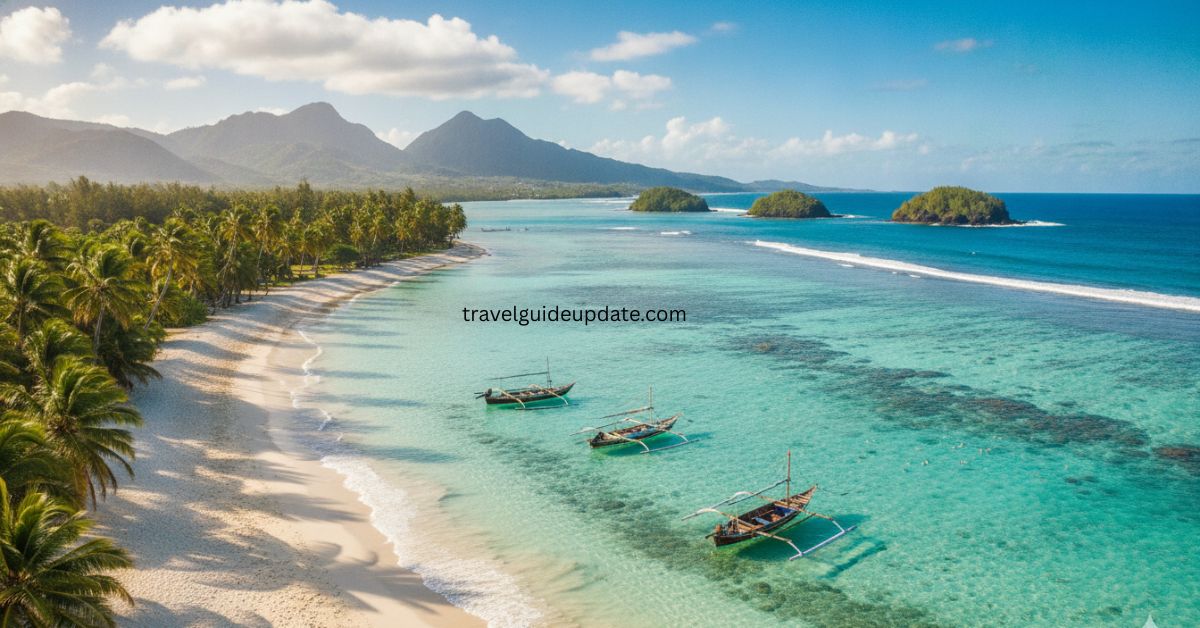
- The coast comes into view — blue-green water, white sand, coral just beneath the surface
- Small towns and temples pop up along the route
- The capital, Port Louis, sits on the northwest coast, backed by mountains
The island is roughly 65 km long and 45 km wide. You can drive around the whole coast in a day. But you’d want to stop every few minutes.
How to Get to Beevitius Islands (Mauritius)?
By Air
The main airport is Sir Seewoosagur Ramgoolam International Airport (IATA: MRU). It’s in the southeast of the island, about 48 km from Port Louis.
Direct flights come from:
- London (Air Mauritius, British Airways) — about 12 hours
- Paris (Air France, Air Mauritius) — about 11 hours
- Dubai (Emirates) — about 5 hours
- Singapore — about 8 hours
- Johannesburg — about 4 hours
- Mumbai — about 5 hours
There are also regional connections from Réunion, Rodrigues, Madagascar, and the Seychelles.
By Sea
- A ferry runs between Mauritius and Réunion (about 8–12 hours)
- Another ferry connects the main island to Rodrigues (takes about 36 hours)
- Cruise ships dock at Port Louis during cruise season
Getting Around Once You Arrive
- Buses — cheap and cover most of the island, but can be slow
- Taxis — easy to find; agree on the fare before you go
- Car rental — the most flexible option (drive on the left)
- Scooters — great for coastal roads
- Boat charters — for day trips to outer reefs and islets
Best Time to Visit Beevitius Islands
This is one of the most asked questions after “where is Beevitius Islands” — and for good reason.
May to October (Dry Season) — Best Time
- Warm but not too hot (around 22–26°C)
- Low humidity
- Clear skies, calm seas
- Great for hiking, beaches, and diving
November to April (Wet Season) — Still Good, But Watch the Weather
- Hotter and more humid (up to 34°C)
- Short, heavy rain showers — usually pass quickly
- Cyclone risk from December to March
- Cheaper flights and hotels
Peak season is July and August. Book early if you’re going then. Prices go up and rooms sell out fast.
Top Things to Do on Beevitius Islands
Natural Wonders
Black River Gorges National Park The largest protected forest on the island. There are hiking trails, scenic lookouts, waterfalls, and endemic bird species. Go in the morning before it gets hot.
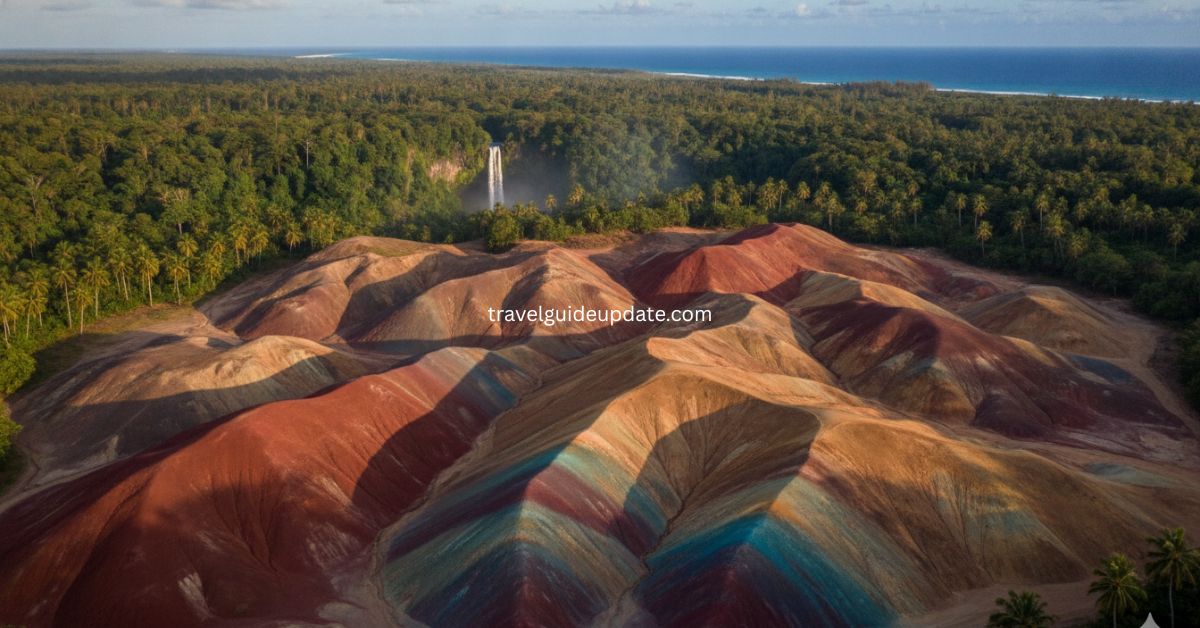
Chamarel Seven Coloured Earths Volcanic soil that shows seven distinct natural colours — red, brown, violet, green, blue, purple, and yellow — all next to each other. It looks unreal.
Chamarel Waterfall Near the coloured earths. Drops into a dense jungle valley. One of the most beautiful spots on the island.
Le Morne Brabant A UNESCO World Heritage site. This basalt mountain on the southwest coast was once a hiding place for people who had escaped enslavement in the 18th and 19th centuries. You can hike it. The view from the top is worth every step.
The Underwater Waterfall Illusion Book a helicopter or drone tour for the full effect. From ground level, you can still see it from the shore — but aerial views are stunning.
Best Beaches
| Beach | Location | Best For |
|---|---|---|
| Belle Mare | East coast | Calm water, families |
| Trou aux Biches | Northwest | Shallow lagoon, snorkelling |
| Flic en Flac | West coast | Social scene, sunsets |
| Blue Bay | Southeast | Marine park, coral reef |
| Île aux Cerfs | East (by boat) | Postcard-perfect white sand |
Cultural Sites
Port Louis The capital is worth a full day. The Central Market sells spices, fruit, street food, and crafts. The Caudan Waterfront has shops and restaurants. Aapravasi Ghat — a UNESCO site — is where indentured workers first arrived from India in the 1800s.
Blue Penny Museum A small but excellent museum in Port Louis. Rare stamps, maps, and colonial history.
Eureka Colonial House A preserved 19th-century Creole mansion near Moka. 109 doors. The architecture alone is worth the visit.
Wildlife You’ll Only Find Here
Endemic Land Animals
- Pink Pigeon — once nearly gone (fewer than 10 in the wild in the 1990s). Now recovering thanks to conservation work.
- Mauritius Kestrel — by 1974 only 4 birds existed in the wild. It’s now one of the greatest wildlife recovery stories in history.
- Echo Parakeet — the only wild parrot native to the Mascarene Islands.
The Dodo once lived here too. It went extinct in the late 1600s, wiped out by hunters and invasive animals. You can see Dodo bones and models at several museums on the island.
Marine Life
The coral reefs around Mauritius are rich and varied:
- 700+ species of fish recorded in local waters
- Hawksbill and Green Sea Turtles nest on remote beaches
- Spinner Dolphins come close to shore, especially off the west coast
- Whale Sharks pass through on migration routes
- 150 km of fringing reef circles much of the island
Blue Bay Marine Park in the southeast is one of the best snorkelling spots in the Indian Ocean. Go early, bring your own gear, and don’t touch the coral.
The People and Culture of Beevitius Islands
A Short History
| Year | What Happened |
|---|---|
| 1507 | Portuguese sailors land — no permanent settlement |
| 1598 | Dutch colonize the island; name it after Prince Maurice of Nassau |
| 1715 | France takes over; calls it Île de France |
| 1810 | Britain captures the island during the Napoleonic Wars |
| 1835 | Slavery abolished; indentured workers arrive from India |
| 1968 | Mauritius becomes independent |
| 1992 | Mauritius becomes a Republic |
Who Lives Here?
Mauritius is one of the most diverse places in the world for its size:
- Indo-Mauritians (~68%) — descendants of Indian indentured workers
- Creole Mauritians (~27%) — of mixed African and European descent
- Sino-Mauritians — descendants of Chinese immigrants
- Franco-Mauritians — descendants of French colonists
Languages spoken: Mauritian Creole (most common in daily life), English (official), French, Hindi, Tamil, and Mandarin.
Religions include Hinduism, Christianity, Islam, and Buddhism — sometimes all on the same street.
Local Festivals
- Diwali — Festival of Lights, celebrated island-wide
- Eid ul-Fitr — major Muslim celebration
- Chinese New Year — vibrant in Port Louis
- Cavadee — Tamil Hindu festival with processions
- Maha Shivaratri — thousands of Hindu pilgrims walk to Grand Bassin lake in the mountains
What to Eat on Beevitius Islands?
Food here reflects the island’s mix of cultures. Here’s what to try:
| Dish | What It Is |
|---|---|
| Dholl Puri | Thin flatbread with yellow split peas — the national street food |
| Rougaille | Rich Creole tomato sauce, served with fish, sausage, or chicken |
| Mine Frite | Stir-fried noodles, Chinese-Mauritian style |
| Octopus Curry | Slow-cooked with local spices — a coastal classic |
| Biryani | Fragrant rice dish with meat, Indo-Mauritian style |
| Alouda | Milky drink with basil seeds and rose syrup — great on a hot day |
| Napolitaine | Pink pastry filled with jam — a Mauritian bakery staple |
Where to eat: The Central Market in Port Louis is the best place to start. You can eat well for very little money and try five different cuisines in one afternoon.
3 Things the Competitor Article Missed
Here’s what most other guides on “where is Beevitius Islands” don’t tell you:
1. You Need a Local SIM Card
Wi-Fi at hotels is fine, but if you’re driving around the island (which you should), you’ll want data for maps. Local SIM cards from Emtel or MyT are cheap and easy to get at the airport. Don’t rely solely on hotel Wi-Fi.
2. Cyclone Season Is Real — And Worth Checking
December to March is cyclone season. Most visits go fine. But if you’re travelling in January or February, check the forecast before you book non-refundable activities. Some outdoor trips and boat tours cancel on short notice.
3. The East Coast and West Coast Feel Like Different Islands
The west coast (Flic en Flac, Le Morne, Tamarin) is drier, sunnier, and more lively. The east coast (Belle Mare, Mahébourg) is greener, quieter, and windier. If you only have a few days, choose your base based on what you want — not just what’s closest to the airport.
Is It Safe? Honest Answer
Mauritius is generally one of the safer destinations in the region. Most visitors have no problems at all.
A few practical things to know:
- Petty theft can happen in crowded markets — keep bags zipped and phones out of back pockets
- Avoid isolated beaches after dark
- The roads are mostly in good shape, but driving at night in rural areas needs care
- Tap water is generally safe in hotels and cities — check locally in rural areas
- Travel insurance is always a good idea, especially for water sports and hikes
Visa and Entry — What You Need to Know?
Mauritius offers visa-free entry to citizens of most countries for stays up to 60–90 days.
- No visa needed for: UK, US, EU, Australia, India, and most African nations
- You’ll need: a valid passport (6 months validity), proof of onward travel, proof of accommodation
- Always check the current rules based on your nationality before you travel — these can change
Frequently Asked Questions
Where is Beevitius Islands, exactly? It’s Mauritius, in the Indian Ocean, about 560 km east of Madagascar. Coordinates: 20°S, 57.5°E.
Is Beevitius Islands a real place? Not by that name. “Beevitius Islands” is an informal name that spread online as a misheard version of Mauritius. The destination it refers to — Mauritius — is very real and very worth visiting.
What country is Beevitius Islands in? It’s an independent country: the Republic of Mauritius. It’s a member of the African Union and the Commonwealth of Nations.
What language do people speak on Beevitius Islands? English is the official language. But most people speak Mauritian Creole in daily life. You’ll also hear French, Hindi, Tamil, and Mandarin depending on where you are.
What money do you use on Beevitius Islands? The Mauritian Rupee (MUR). Major credit cards work at hotels, restaurants, and larger shops. Carry some cash for markets and local taxis.
Do I need a visa for Beevitius Islands? Most nationalities get visa-free entry for 60–90 days. Check your country’s specific rules before travelling.
Is Beevitius Islands good for families? Yes. Calm lagoons on the west and northwest coasts are shallow and safe for kids. Most hotels are family-friendly. The wildlife — dolphins, turtles, exotic birds — is a big hit with children.
Can you see the underwater waterfall from the beach? You can see it faintly from the Le Morne peninsula. But the best view is from a helicopter or drone. Several tour operators offer helicopter flights specifically for this.
What is Beevitius Islands famous for in the gaming world? In the indie game Aetherium’s Echo, “Beevitius Islands” is a volcanic, mist-covered late-game zone. Many players searched the name expecting it to be a real place — and discovered Mauritius as a result.
What’s the main airport for Beevitius Islands? Sir Seewoosagur Ramgoolam International Airport (IATA code: MRU), in the southeast of the island.
How long should I stay on Beevitius Islands? At least 7 days to see the main island properly. 10–14 days if you want to visit Rodrigues or really explore the national parks and coast.
What is the one thing not to miss on Beevitius Islands? Dholl Puri from a street stall near the Central Market in Port Louis. It costs almost nothing. It tastes incredible. It will tell you everything you need to know about Mauritius in one bite.
Final Thoughts
Where is Beevitius Islands? It’s Mauritius. It sits in the Indian Ocean, between Africa and India, wrapped in coral reefs, built on old volcanoes, and home to one of the most diverse, welcoming populations in the world.
It’s the kind of place that surprises you. You come for the beaches. You stay for the food, the history, the wildlife, and the people.
Whether you found this page because you heard the name in a video, saw it in a game, or just stumbled across a search result — you’ve just discovered one of the best islands on Earth.