So you want to become a certified travel agent — or you’re already working and want to prove you’re the real deal.
Either way, you’re in the right place.
Getting certified sets you apart fast. It tells clients you know what you’re doing. It tells vendors and suppliers you take this seriously. And it often means you earn more.
But here’s the problem: there are a lot of certificates out there. CTA, CTC, CTIE, IATA, CLIA — the alphabet soup gets confusing fast.
This guide breaks all of it down. We’ll cover every major certificate, what it costs, how long it takes, and who it’s best for. No fluff, no filler.
Why Get a Travel Agent Certification at All?
Good question. You don’t need a certificate to sell travel in most countries. It’s not like being a doctor or a lawyer.
But here’s the thing — clients don’t know that.
When a couple hands over $8,000 for a honeymoon trip, they want to trust you. A certificate on your profile page does a lot of work. It says: “This person trained hard. They passed a test. They’re serious.”
Here are the real benefits:
- Higher trust from new clients. First impressions matter. Credentials help.
- Better supplier relationships. Hotels, cruises, and tour operators often give better deals to certified agents.
- Higher earning potential. Certified agents typically earn more than those without credentials.
- Stand out in a crowded market. Anyone can call themselves a travel agent. Few have letters after their name.
- Network access. Many certifications come with access to industry groups, events, and job boards.
If you’re treating this as a real career, a certificate is worth it.
The 5 Main Travel Agent Certifications Explained
Here’s a clear look at the most recognized certificates in the travel industry today.
1. CTA — Certified Travel Associate
Best for: New agents or those with less than 5 years of experience.
The CTA is your starting point. It’s offered by The Travel Institute and is one of the most respected entry-level credentials in the U.S. travel industry.
To qualify, you need at least 12 months of travel industry experience. But if you’re brand new, you can still start the coursework — you just can’t sit the exam until you hit that 12-month mark.
What you’ll study:
- Selling and communication skills
- Customer service
- Geography and destinations
- Industry tools and booking systems
How long it takes: Most people finish in 2 to 4 months, studying part-time.
Exam: Online, open book, 75 questions. You need to score 70% or higher to pass.
Cost: Around $250–$350 depending on membership status.
Renewal: 10 Continuing Education Units (CEUs) per year to keep it active.
2. CTC — Certified Travel Counselor
Best for: Agents with 5+ years of experience ready to move into management.
The CTC is the next step up. It’s been the gold standard in the U.S. travel industry for over 50 years. Suppliers, agencies, and clients all recognize the CTC as a mark of serious expertise.
You must hold a CTA first before you can pursue the CTC.
What you’ll study:
- Management and leadership skills
- Business strategy
- Advanced sales techniques
- Industry white papers and case studies
How long it takes: 3 to 6 months for most working agents.
Exam: Online, multiple modules with short quizzes and a final exam.
Cost: Around $300–$450.
Renewal: 10 CEUs per year, plus Travel Institute membership.
3. CTIE — Certified Travel Industry Executive
Best for: Agency owners, directors, and senior industry leaders.
The CTIE is the top tier. It’s designed for people who run teams, agencies, or travel companies. If you’re in a leadership role or heading that way, this is your target.
You must hold a CTC to be eligible for the CTIE.
What you’ll study:
- Executive leadership
- Strategic planning
- HR and team management
- Industry trends and white papers
Cost: Around $350–$500.
Renewal: 10 CEUs per year.
4. ASTA Verified Travel Advisor (VTA)
Best for: Agents who want an ethics-focused credential that clients can see.
The American Society of Travel Advisors (ASTA) offers the VTA program. It’s less about technical skills and more about building client trust through a verified code of conduct.
It’s a great complement to the CTA or CTC — not a replacement.
What you’ll study:
- Travel industry ethics
- Legal basics (consumer protection)
- Business conduct standards
Cost: Around $149–$199 for ASTA members.
Time: About 8–10 hours of online study.
5. CLIA Certifications
Best for: Agents who specialize in cruise travel.
The Cruise Lines International Association (CLIA) has its own certification track. If you love selling cruises, this is a big deal. Cruise lines pay attention to CLIA credentials when handing out FAM trips and higher commission tiers.
CLIA levels include:
- ACC — Accredited Cruise Counsellor (entry level)
- MCC — Master Cruise Counsellor (mid-level)
- ECC — Elite Cruise Counsellor (expert level)
- LCC — Luxury Cruise Counsellor (premium niche)
Cost: Varies by level, from $50 to $300+.
Side-by-Side Comparison: Which Certificate Is Right for You?
| Certificate | Offered By | Experience Needed | Cost (approx.) | Best For |
|---|---|---|---|---|
| CTA | The Travel Institute | 12 months | $250–$350 | New/early-career agents |
| CTC | The Travel Institute | 5 years + CTA | $300–$450 | Mid-career agents |
| CTIE | The Travel Institute | CTC required | $350–$500 | Agency leaders |
| VTA | ASTA | None | $149–$199 | Ethics + client trust |
| ACC/MCC/ECC | CLIA | None to moderate | $50–$300+ | Cruise specialists |
What About IATA Certification?
You’ll see IATA (International Air Transport Association) mentioned a lot. But IATA accreditation is for travel agencies, not individual agents.
If you want your own agency to issue airline tickets directly, you apply for IATA accreditation as a business. It’s a different process — more like a business license than a personal certificate.
Individual agents don’t need IATA numbers. Your host agency or employer typically holds this.
How to Get Your First Certification?: Step-by-Step
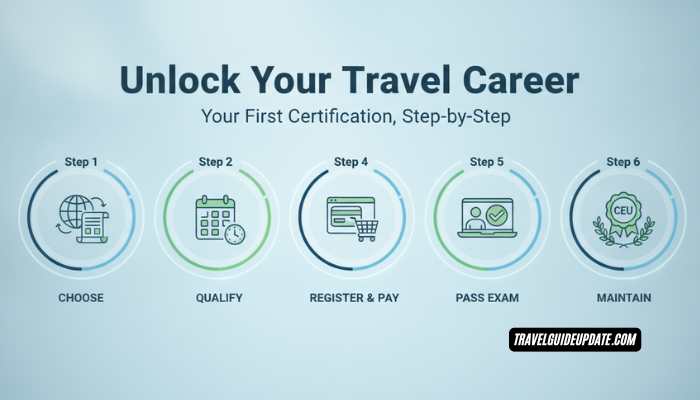
Here’s the simple path from zero to certified:
Step 1: Choose your certificate. If you’re new, start with the CTA. If you specialize in cruises, add the ACC from CLIA.
Step 2: Meet the eligibility requirements. For the CTA, you need 12 months of experience. Start the coursework now; schedule the exam when you hit that mark.
Step 3: Register and pay. Sign up through the issuing body’s website. Travel Institute membership saves you money on fees.
Step 4: Complete the coursework. All programs are online and self-paced. Most people study 3–5 hours per week.
Step 5: Pass the exam. Most exams are online with open-book formats. Review all modules before sitting.
Step 6: Earn your CEUs. After certification, you earn 10 CEUs per year to stay active. Webinars, courses, and industry events all count.
3 Things Most Certification Guides Won’t Tell You
1. Your host agency often pays for it
If you work under a host agency, ask them first. Many host agencies cover or subsidize certification costs for their agents. It’s worth a quick email before you spend your own money.
2. FAM trips get easier with credentials
Suppliers and tourism boards often require or strongly prefer certified agents when offering familiarization (FAM) trips. These are free or low-cost trips that let you experience destinations firsthand. More credentials = more invitations.
3. You can stack credentials strategically
You don’t have to pick one. A smart move is CTA + CLIA ACC + ASTA VTA. This covers general expertise, cruise specialization, and client trust — three angles that make your profile very strong.
Do Online Travel Agents Need Certification Too?
Yes — and maybe more so.
If you’re working remotely or building an online travel business, you don’t have a physical office to signal professionalism. Your credentials are doing all that work for you.
Clients searching for a travel agent online will compare profiles. A listing with “CTA, CLIA Certified” beats a blank profile every time.
How Much Can Certified Travel Agents Earn?
Salaries vary a lot based on specialization, location, and experience. Here’s a rough picture:
| Agent Type | Average Annual Earnings (U.S.) |
|---|---|
| New agent (no cert) | $28,000–$36,000 |
| Certified (CTA) | $38,000–$52,000 |
| Senior (CTC) | $50,000–$70,000 |
| Agency owner/exec | $75,000–$120,000+ |
| Top luxury specialists | $100,000+ |
Certification alone won’t make you rich. But it often unlocks higher commission tiers, better supplier deals, and premium clientele who pay higher prices for better service.
Frequently Asked Questions
How long does it take to get travel agent certified? The CTA takes most people 2–4 months of part-time study. The CTC and CTIE take 3–6 months each. Plan for about a year if you’re going through all three levels.
Can I get certified without experience? You can start studying for the CTA anytime. But you need 12 months of travel industry experience before you can sit the exam. Use that time to work at a host agency or travel company.
Is the CTA exam hard to pass? Most people who prepare properly pass on their first try. The exam is open book and online. You need 70% or higher. Focus on the selling skills and destination knowledge modules.
Do I need certification to work at a travel agency? Not always. Many agencies hire without it and let you certify on the job. But having a CTA before applying makes your resume stand out immediately.
How do I keep my certification active? Earn 10 CEUs per year. These come from webinars, courses, industry events, and supplier training. It’s easy to hit 10 if you stay active in the industry.
Is there a free travel agent certification? Some supplier training programs (like those from cruise lines or tourism boards) are free. They’re not the same as CTA or CTC, but they count toward CEUs. There’s no free version of the main Travel Institute certifications.
What’s the difference between a travel agent and a travel advisor? Just branding. Many professionals now prefer “travel advisor” to signal they offer expert guidance, not just bookings. Certifications apply equally to both titles.
Is IATA certification for individual agents? No. IATA accreditation is for travel agencies as businesses. Individual agents don’t need it directly.
Can I specialize and get certified in a niche? Yes. CLIA certifications cover cruise specialization. Many tourism boards (e.g., Tourism Australia, Jamaica Tourist Board) offer their own destination-specialist certificates. Stacking niche credentials is a great strategy.
Which certification do most employers ask for? The CTA is the most commonly requested entry-level credential. Larger agencies often prefer or require the CTC for senior roles.
Conclusion
Travel agent certification isn’t mandatory, but it can be one of the smartest investments you make in your career. Whether you start with the CTA, specialize through CLIA, or work toward advanced credentials like the CTC and CTIE, certification helps build trust, improve industry knowledge, and open doors to better opportunities. It won’t guarantee success on its own, but it can give you a clear advantage in a competitive market. Choose the certification that matches your experience level, stay committed to learning, and you’ll be well positioned to grow a rewarding and profitable career in the travel industry.