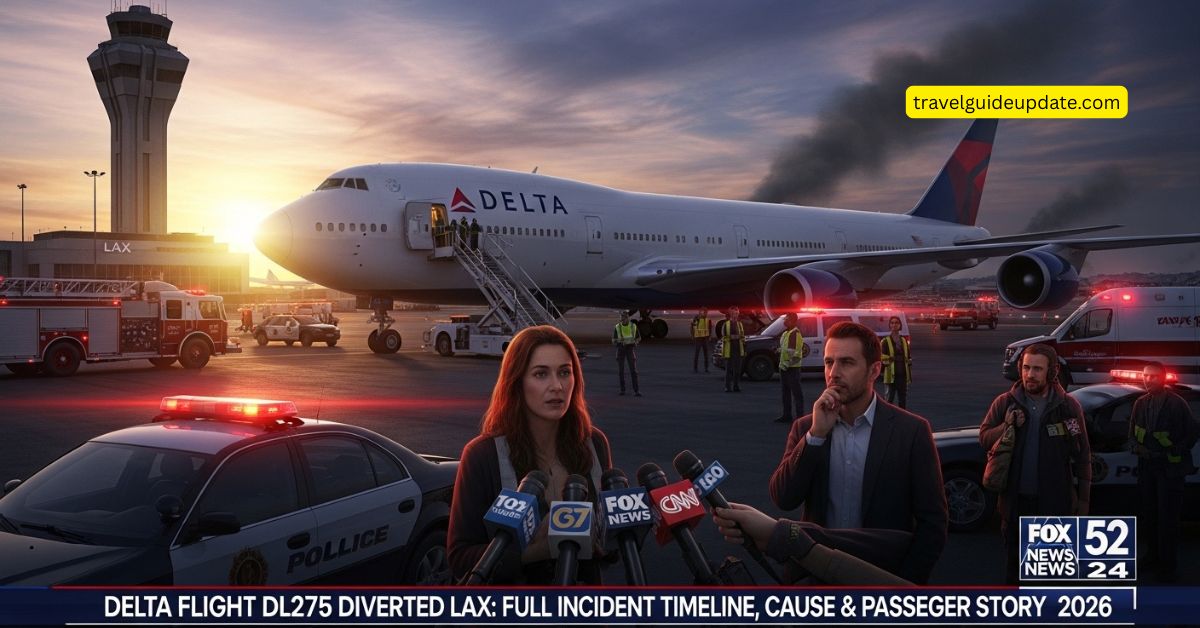
On May 28, 2025, Delta Flight DL275 made headlines. The flight was headed from Detroit to Tokyo. It never made it. Instead, all 287 passengers landed at Los Angeles International Airport — thousands of miles from their destination.
This wasn’t a crash. Nobody was hurt. But it was a big deal.
In this article, you’ll get the full story. We cover what caused the diversion, exactly when it happened, how Delta handled it, and what rights you have if this ever happens to you.
What Is Delta Flight DL275?
DL275 is a daily long-haul flight run by Delta Air Lines. It connects Detroit Metropolitan Wayne County Airport (DTW) with Tokyo Haneda Airport (HND) in Japan.
The flight typically takes around 13 hours. It crosses the North Pacific Ocean — one of the most remote air routes in the world.
Here’s a quick snapshot of the flight:
| Detail | Info |
|---|---|
| Flight Number | Delta DL275 |
| Route | Detroit (DTW) → Tokyo Haneda (HND) |
| Aircraft | Airbus A350-900 |
| Engine Type | Rolls-Royce Trent XWB |
| Normal Flight Time | ~13 hours |
| Passengers on May 28 | 287 |
| Diversion Airport | Los Angeles (LAX) |
This route crosses open ocean for most of its journey. That matters — because out there, there are very few places to land in an emergency.
What Happened on May 28, 2025?
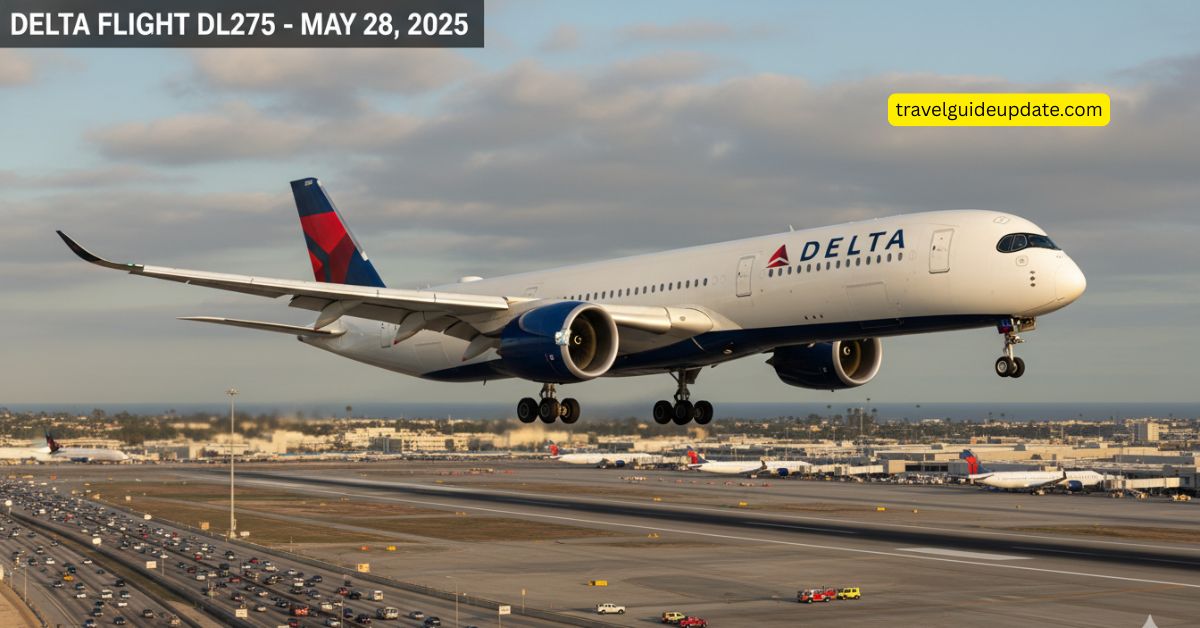
The Flight Took Off Normally
On the afternoon of May 27, 2025, DL275 pushed back from Gate A46 in Detroit. There was a small delay — a late inbound plane from Amsterdam caused the holdup. Nothing serious.
Passengers settled in. The A350 climbed to 38,000 feet and headed northwest. The trip to Tokyo looked routine.
A Warning Light Changed Everything
About 5 to 6 hours into the flight, an alert fired in the cockpit. The crew saw a fault in the engine anti-ice system on one of the Rolls-Royce Trent XWB engines.
This happened over the Bering Sea, roughly 620 nautical miles southwest of Anchorage, Alaska.
What Is an Engine Anti-Ice System?
Here’s the simple version:
At high altitudes, temperatures can drop below –50°C (–58°F). Ice can form on engine parts very fast. If ice builds up and breaks off, it can damage the engine badly.
The anti-ice system stops that from happening. It heats key parts of the engine to keep them clear.
When this system fails, pilots can’t safely continue a long over-water flight. Ice could form. Engines could be damaged. The crew had to act.
Why Did They Choose LAX — Not Anchorage?
This is a smart question. Anchorage, Alaska, was actually closer at the time.
But the crew chose LAX instead. Here’s why:
- LAX has full maintenance facilities for the Airbus A350-900.
- LAX has Delta hub resources — spare parts, engineers, and staff.
- LAX can handle 287 passengers with hotels, rebooking desks, and food.
- Anchorage lacks most of these resources for a wide-body aircraft emergency.
The pilots turned the plane around. The A350 flew for about 5 hours back to the West Coast.
Full Incident Timeline
| Time | Event |
|---|---|
| May 27 – Afternoon | DL275 departs Detroit (DTW), slight delay |
| ~5–6 hrs into flight | Anti-ice system fault detected over Bering Sea |
| 620 nm SW of Anchorage | Crew decides to divert to LAX |
| ~5 more hours | Aircraft flies back across Pacific toward California |
| 1:08 AM PDT, May 28 | DL275 begins approach to LAX |
| 1:38 AM PDT, May 28 | DL275 lands safely on Runway 06R at LAX |
| Post-landing | Delta staff meet passengers; rebooking begins |
The whole crew stayed calm. The landing was smooth. No injuries. No panic.
How Did Passengers React?
Flying over an ocean and then hearing your flight is turning around — that’s not easy news.
Here’s what passengers reportedly experienced on board:
- The captain made clear, calm announcements about the situation.
- Cabin crew kept everyone calm and answered questions.
- Most passengers stayed in their seats without panic.
- After landing, many took to social media to share their relief.
On platforms like X (formerly Twitter) and Reddit, travelers praised the crew’s handling. Many said they felt informed the whole time. A few expressed frustration about missed plans — especially those connecting to other cities in Asia.
One common theme stood out: people were scared, but the crew’s calm made a big difference.
Was Anyone Hurt?
No. All 287 passengers and crew landed safely.
This is important. The diversion wasn’t a crash or a near-miss. It was a precautionary action — exactly what pilots are trained to do.
The aviation safety system worked as it was designed. A warning light fired. The crew assessed the risk. They made the safest call. Everyone got home.
How Did Delta Respond?
Delta’s ground response at LAX was swift. Here’s what the airline did:
- Delta staff met passengers at the gate to explain the next steps.
- Meal vouchers were provided to passengers waiting for rebooking.
- Hotel accommodations were arranged for those who needed to rest overnight.
- Rebooking assistance was available immediately for onward travel.
- Email and app notifications were sent to update passengers in real time.
Delta also offered compensation for the travel disruption. This followed the airline’s standard policy for delays and diversions caused by mechanical issues.
What Are Your Rights as a Passenger After a Diversion?
This is where most articles fail you. Let’s fix that.
If your flight is diverted due to a mechanical issue, here’s what you’re typically entitled to:
In the United States (DOT Rules):
- Rebooking on the next available flight at no extra charge.
- Full refund if you choose not to travel.
- Meals and refreshments during long waits (many airlines offer this voluntarily).
- Hotel accommodation if you’re stranded overnight (some airlines cover this for mechanical issues).
Pro Tips If Your Flight Is Diverted:
- Ask immediately about compensation — don’t wait.
- Keep all receipts for food, hotels, and transport you pay out of pocket.
- File a claim online through Delta’s customer care portal within 30 days.
- Check your travel insurance — many policies cover trip disruption costs.
- Use your credit card’s travel protection — many premium cards include flight delay coverage.
What Is ETOPS and Why It Matters Here?
You may see the term ETOPS come up in stories about this flight. Here’s what it means.
ETOPS stands for Extended-range Twin-engine Operational Performance Standards.
It’s a set of rules that allows twin-engine planes (like the A350) to fly long over-water routes. Without ETOPS, a twin-engine jet couldn’t legally fly more than 60 minutes from a diversion airport.
Delta holds ETOPS-180 and ETOPS-370 certification on this route. That means the A350 is approved to fly up to 370 minutes from an alternate airport under normal conditions.
But when a key system like the anti-ice fails, those limits change. The crew must divert to the nearest suitable airport — not just the nearest one.
LAX fit the bill perfectly.
The Cost of the Diversion
Diversions are expensive — not just stressful. Here’s an idea of the financial impact:
| Cost Category | Estimated Amount |
|---|---|
| Fuel for diversion flight | Significant — extra ~5 hrs fuel burn |
| Aircraft maintenance at LAX | High — Rolls-Royce system repair |
| Passenger care (hotels, meals) | Hundreds of thousands |
| Lost revenue (Tokyo leg) | ~$1.9 million (estimated) |
| Total operational cost | ~$5.9 million (estimated) |
These numbers come from multiple aviation industry analyses. They show why airlines don’t divert lightly — but also why safety is always worth the cost.
Similar Diversion Incidents in Aviation History
DL275 is far from the first. Diversions happen more often than most people think.
Here are a few well-known cases:
- United Airlines Flight 328 (2021): A Boeing 777 suffered an engine failure shortly after takeoff from Denver. It returned safely. No injuries.
- Air Canada Flight 759 (2017): Lined up to land on a taxiway instead of a runway at SFO. Air traffic control caught it in time.
- Qantas Flight 32 (2010): An A380 suffered a severe engine explosion over Indonesia. The crew managed an emergency landing in Singapore. All 469 people survived.
What do these incidents have in common? Trained crews who followed safety protocols. That’s exactly what happened on DL275.
What This Tells Us About Modern Aviation Safety?
A lot of people hear “engine warning” and imagine the worst. The reality is different.
Modern aircraft like the A350 are built with layers of backup systems. One part fails — another takes over. Pilots train for these moments constantly. They don’t panic. They follow checklists.
The DL275 incident is actually a success story for aviation safety:
- The fault was detected early.
- The crew made a calm, correct decision.
- Everyone landed safely.
- Delta handled the aftermath professionally.
No one was hurt. That’s the whole goal.
What the A350-900 Is Built For?
The Airbus A350-900 is one of the best long-haul aircraft in the world. Here’s why it’s trusted on routes like DTW–HND:
- Made with 50% carbon fiber — lighter and stronger than older jets.
- Twin Rolls-Royce Trent XWB engines — among the most efficient ever made.
- Range of up to 15,000 km — perfect for transpacific routes.
- Advanced cockpit systems that catch faults early.
- Cabins designed for long-haul comfort.
Even with the anti-ice fault, the aircraft flew safely for 5 more hours back to LAX. That’s a testament to how well it’s built.
Frequently Asked Questions (FAQs)
Was Delta Flight DL275 an emergency landing?
It was a precautionary diversion, not a crash or declared emergency. The crew detected a technical fault and chose the safest course of action. All passengers and crew were safe.
What caused DL275 to divert to LAX?
A malfunction in the engine anti-ice system on one of the Rolls-Royce Trent XWB engines. This was detected over the Bering Sea, about 5–6 hours into the flight.
Why did they land at LAX instead of Anchorage?
LAX offered better maintenance facilities, more Delta staff and resources, and could handle rebooking and care for 287 passengers more effectively than Anchorage.
Were any passengers hurt?
No. All 287 passengers and crew landed safely with no injuries reported.
Did Delta compensate passengers?
Yes. Delta provided meal vouchers, hotel accommodations, and rebooking assistance. Passengers were also eligible for compensation under Delta’s standard delay/diversion policies.
How long was the delay caused by the diversion?
The diversion added roughly 10 hours to the journey — 5 hours of return flight to LAX, plus ground time for rebooking and rescheduling.
How common are flight diversions?
More common than most people think. In the U.S. alone, hundreds of diversions occur each year due to weather, medical emergencies, and technical issues. Most end safely.
What should I do if my flight is diverted?
Stay calm, listen to crew instructions, ask Delta staff about rebooking and compensation right away, and keep receipts for any expenses you incur.
Can I get a full refund if my flight is diverted?
Yes. U.S. Department of Transportation rules allow you to request a full refund if you choose not to travel following a diversion caused by a mechanical issue.
Is the Airbus A350-900 safe?
Yes. It’s one of the safest and most advanced commercial aircraft in service. The DL275 incident actually shows the safety systems working exactly as intended.
Final Thoughts
Delta Flight DL275’s diversion to LAX on May 28, 2025, looked scary at first. But it turned out to be a great example of aviation safety doing its job.
The crew caught a problem early. They made the right call. They landed safely. Delta took care of its passengers. And the whole story ended without a single injury.
If you were on that flight — or on any flight that diverts — know this: the system is designed to protect you. Pilots train for years for moments like this. The outcome on DL275 proves that training works.