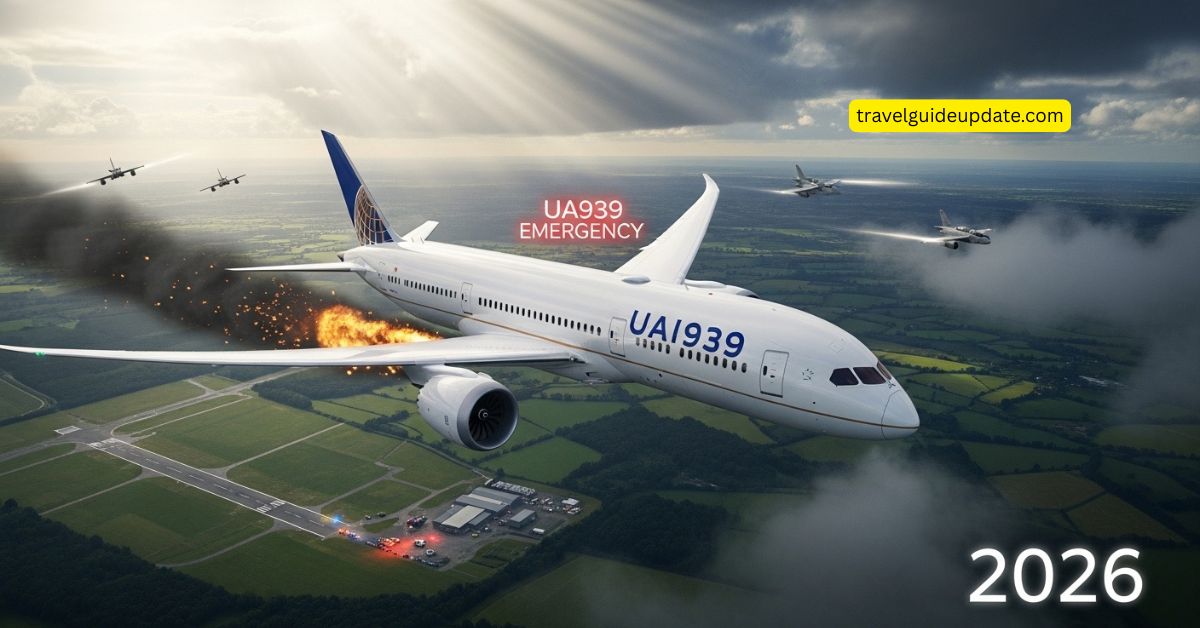
On September 28, 2025, United Airlines flight UA939 had a serious problem in the sky. The plane left London and never made it to San Francisco. Here is the full story — what happened, why it happened, and what passengers went through.
What Was Flight UA939?
Flight UA939 is a United Airlines route. It flies from London Heathrow (LHR) to San Francisco International Airport (SFO) in California. The trip takes about 10 hours.
On this day, the plane was a Boeing 777-200ER. Its tail number was N788UA. This aircraft was 28 years old. United Airlines got it in July 1997.
| Flight Detail | Info |
|---|---|
| Flight Number | UA939 |
| Aircraft | Boeing 777-200ER |
| Registration | N788UA |
| Aircraft Age | 28 years (delivered July 1997) |
| Route | London Heathrow → San Francisco |
| Passengers | 271 |
| Crew | 13 |
| Scheduled Flight Time | ~10 hours |
The Emergency: A Minute-by-Minute Timeline
Here is exactly what happened that evening, step by step.
16:21 BST – Takeoff from London Heathrow
The plane left Heathrow on time. Everything looked normal at first.
Under 60 Minutes Into the Flight – Vibrations Detected
While cruising at 31,000 feet over northern England near Blackpool, the flight crew felt something wrong. The pilots noticed abnormal vibrations across the airframe. These were not normal flight vibrations. They were a sign of a bigger problem.
The crew did not guess. They acted. They got in touch with United’s maintenance and dispatch teams on the ground. Together, they tried to find the cause.
17:30 BST – Aircraft Holds at 31,000 Feet
The pilots put the plane into a holding pattern. The aircraft flew in circles while the crew worked out what to do next. This kept the plane safe and gave them time to think.
17:36 BST – New Departure Time Announced
United Airlines told passengers a new departure would happen about 2 hours and 53 minutes after the original time. At this point, the full picture was not yet clear.
17:50 BST – Emergency Confirmed: Right Engine Problem
Confirmation came through. The crew declared a full emergency. The cause: a right-hand engine issue. To land safely, the plane needed to lose weight. So the pilots began fuel dumping — releasing excess fuel into the air. This is a normal safety step before an emergency landing. It lowers the risk of fire on touchdown.
The crew also shut down the affected engine as a precaution. A Boeing 777 can fly safely on one engine. That’s part of how this plane is built.
After 17:50 BST – Safe Return to Heathrow
The plane landed safely back at London Heathrow. No injuries were reported. All 271 passengers and 13 crew members were safe.
Final Update – Flight Canceled
United Airlines canceled the flight. Passengers were moved to other available flights.
Why Did the Engine Have a Problem?
The Pratt & Whitney PW4090 Engine
The Boeing 777-200ER uses Pratt & Whitney PW4090 engines. This engine model is older. It is no longer in production. As engines age, wear and fatigue can build up over time. This can lead to vibrations or other issues.
The crew felt vibrations across the whole airframe. This can happen when an engine is not running smoothly. In some cases, a fan blade or part inside the engine can cause shaking.
The Aircraft’s Age
N788UA was 28 years old at the time of this incident. That is not unusual in aviation. Many airlines fly older aircraft with careful maintenance. But older planes do need more attention. Parts wear out faster. Checks must happen more often.
What Reports Said?
Reports from The Aviation Herald and other sources confirmed the pilots shut down the number one engine during the flight. They then dumped fuel and returned. The plane stayed on the ground at Heathrow for about 24 hours before flying to San Francisco as a ferry flight — with no passengers on board — for a full inspection.
What Happens During a Mid-Air Emergency Like This?
If you’ve never thought about what pilots do when something goes wrong, here’s a clear picture.
Step 1: Identify the Problem
Pilots have many sensors and warning systems. When something is wrong, alarms go off. The crew checks what the data says.
Step 2: Follow the Checklist
Every emergency has a checklist. Pilots train for these situations again and again. They do not panic. They follow the steps.
Step 3: Talk to the Ground
Pilots call their airline’s maintenance team and air traffic control. They get help deciding the next move.
Step 4: Declare an Emergency (Squawk 7700)
When a pilot declares an emergency, they use a special code — squawk 7700. This tells air traffic control to clear the path and give the plane full priority.
Step 5: Hold or Divert
Sometimes the crew waits in a holding pattern to burn or dump fuel. This makes the landing weight safe. Then they divert to the nearest safe airport — or return to the one they left.
Step 6: Safe Landing
The top goal is always a safe landing. On September 28, this is exactly what happened.
What Is Fuel Dumping and Is It Safe?
Many people worry when they hear “fuel dumping.” Here is the simple truth.
- Fuel dumping is a planned safety step. It is not a sign of panic.
- Heavy planes need more runway to stop. If a plane lands too heavy, it can damage the landing gear or the airframe.
- By dumping fuel, the plane gets to a safe landing weight.
- The fuel releases as a fine mist at high altitude. It breaks down before it reaches the ground.
- It is done over open areas away from towns when possible.
Not all planes can dump fuel. The Boeing 777-200ER can. This is a design feature for exactly these situations.
What Happened to the Aircraft After the Incident?
After landing, N788UA stayed at Heathrow for roughly 24 hours. United Airlines did not put passengers back on this plane right away. Instead, it flew to San Francisco as ferry flight UA3922 on September 29. A ferry flight carries no passengers — just the crew. This let engineers at another base do a full check of the aircraft.
The plane was set to return to service on October 1, 2025, scheduled to fly as UA194 to Munich. That shows how quickly airlines can turn around after such events — but only after full safety checks are done.
What This Means for Passengers?: Your Rights
If you were on UA939, or a flight is canceled because of an emergency, here is what you should know.
In the UK (Since Brexit, UK Rules Apply)
Under UK261, passengers on flights departing the UK are entitled to care and compensation in many cases.
- Right to care: If you wait more than 2 hours for a short flight, or 3–4 hours for a long one, the airline must give you food, drinks, and access to communication.
- Right to a refund or re-routing: If your flight is canceled, you can choose a full refund or a new flight to your destination.
- Compensation: You may be able to claim up to £520 per person for a long-haul flight delay — but only if the cause is within the airline’s control. A genuine mechanical emergency can sometimes be called “extraordinary circumstances,” which may reduce or remove this right. Always check with the airline and your travel insurer.
Tips for Affected Passengers
- Keep all receipts for food, drinks, and hotel stays during the delay.
- Ask the airline in writing for your rebooking or refund.
- Check your travel insurance. Most policies cover flight cancellations due to mechanical issues.
- Do not sign anything waiving your rights at the airport.
How Does This Compare to Other United Airlines Incidents?
United Airlines flies hundreds of flights every day. Emergencies are rare but do happen across all major airlines. Here are some facts.
- In March 2025, United flight UA147 from Heathrow to Newark returned after an engine failure shortly after takeoff. No one was hurt.
- In May 2025, a United flight turned around over the Atlantic after a security scare involving a passenger’s Bluetooth device.
- The Boeing 777 fleet is one of the most flown widebody types in the world. It has a strong safety record overall.
These events do not mean flying is unsafe. They show that safety systems work. Pilots catch problems early and act fast.
What Does This Tell Us About Aging Aircraft?
The Boeing 777-200ER N788UA was 28 years old. This raises a fair question: how old is too old for a commercial jet?
The Truth About Aircraft Age
- The FAA and EASA (Europe’s aviation authority) have rules on how long planes can fly. Age alone does not ground an aircraft.
- Airlines must do regular deep checks called heavy maintenance visits (D-checks). These happen every 6–10 years. Every part is looked at.
- Older aircraft cost more to keep in the air. Parts are harder to find. Labor costs go up.
- Many airlines retire older jets early — not because they are unsafe, but because newer planes burn less fuel and cost less to run.
The Pratt & Whitney PW4090 engine on N788UA is also an older model, no longer made. That makes spare parts harder to source. This is one reason older planes get more scrutiny over time.
Is the Boeing 777 Safe?
Yes. The Boeing 777 is one of the most tested and proven jets ever built. It entered service in 1995 and has carried billions of passengers. Its twin-engine design is built so it can fly safely on one engine if needed — and that is exactly what the crew of UA939 used on the way back to Heathrow.
The FAA and EASA have increased checks on the 777 fleet in recent years, especially around its electrical systems. This shows regulators are watching closely. That is a good thing.
Frequently Asked Questions (FAQs)
What caused the United Airlines UA939 emergency?
The crew felt abnormal airframe vibrations less than one hour into the flight. The issue was traced to a right-hand engine problem. The pilots shut down the engine and returned to London Heathrow.
Were any passengers hurt on flight UA939?
No. All 271 passengers and 13 crew members landed safely. No injuries were reported.
Why did the plane dump fuel before landing?
A fully fueled long-haul jet is too heavy to land safely. Dumping fuel brings the weight down to a safe landing limit. It is a planned and safe step.
How long was the plane grounded after the incident?
The aircraft stayed at Heathrow for about 24 hours. It then flew to San Francisco as a ferry flight (no passengers) for a full inspection.
What should I do if my flight is canceled due to an emergency?
Ask the airline for a full refund or rebooking. Keep receipts for any costs during the wait. Check your travel insurance and know your rights under UK261 (for UK departures).
Is the Boeing 777-200ER safe to fly on?
Yes. The 777-200ER has a very strong safety record. It is built to handle single-engine operations, and pilots train for emergencies regularly. Incidents like UA939 are rare and show safety systems working as designed.
What is a “squawk 7700” code?
It is a code pilots enter into their transponder to tell air traffic control they have a serious emergency. It gives them top priority in the sky and clears their path.
Did United Airlines compensate passengers on UA939?
United Airlines reaccommodated passengers onto other flights. Whether full compensation applies depends on UK261 rules and whether the cause is deemed within the airline’s control.
Final Word
The United Airlines UA939 emergency on September 28, 2025, was serious — but it ended the right way. The pilots acted fast. They followed their training. They kept 271 people safe.
The event also shows how modern aviation safety works. Problems get caught early. Planes return to land. People walk off unhurt.
It does raise real questions about aging aircraft and older engine types. Airlines and regulators will keep watching. But for now, the story of UA939 is one of pilots doing their job well — and the safety systems doing exactly what they were built to do.